Donald Crafton’s chapter, “Pie and Chase,” got me thinking about the differences between gags and slapstick and trying to pinpoint examples in media I’ve seen. While there were some more obvious examples of slapstick that stood out to me in shows like Tom and Jerry, The Pink Panther Show, and Scooby-Doo, Where Are You?, I found that it was actually a bit more difficult for me to pinpoint gags, even though Crafton’s description was more broad than his description for stapstick comedy. I think the reason I had so much difficulty finding gags boils down to two things: first–I am not well versed in the comedy genre. In general, I tend to stray from comedy, with the exception of a few shows and horror comedy, though even then, both can be hit or miss for me. Second– the majority of media I watch is on two opposing ends of the spectrum in terms of narrative focus. I either watch narrative heavy (bordering on dependant) media, like The Devil’s Hour, The Haunting of Hill House, or Harry Potter, or I watch media with very little reliance on narrative, like Hell’s Kitchen, American Ninja Warrior, or Chopping Mall. So finding something that is in between was a bit harder for me. However, Crafton describing a gag as a type of mini-story was helpful for this. Crafton states: “Generally there is a simple plot which frames the gags, with an opening premise and a closing scene which provides a resolution.” (109). It was then that I thought of Brooklyn Nine-Nine, which almost always uses a gag as a cold open to the episode. The episodes themselves have an over arching plot and narrative, but the cold opens almost never have anything to do with it, outside of a few context lines. The cold opens exist as little mini-stories that operate with the same characters and logic as the larger show, but largely exist on their own. A good example of this would be the cold open in season four, episode eight. In the scene, the characters give a few lines of context to why they’re there–something that has to do with the larger plot of the season, before setting up the premise of the scene. Jake Peralta (Andy Samberg) is going to slide across the full bull pen in his socks. The conflict comes where he ends up colliding with his boss, Captain Holt (Andre Braugher) in the elevator, and closes with Holt and Jake exiting the elevator, looking like Jake is about to get in trouble, but subverts expectations with the punch-line– Holt presenting Jake as a champion in his quest. This also follows Crafton’s comic strip logic, as showcased below.
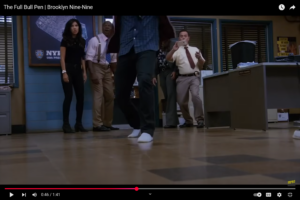


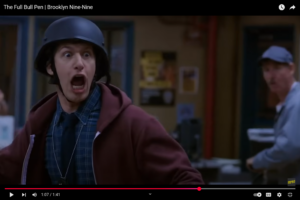

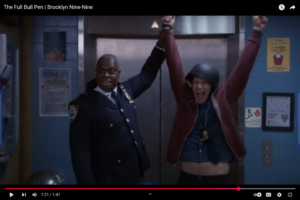
I really like your use of screengrabs to illustrate Crafton’s comic strip logic! The cold open as a mini non-narrative sketch is an interesting format and I wonder how Crafton and Gunning would approach it and whether or not they would agree with each other.
I get what you mean when struggling to find something that isn’t just obvious and wanting to find something in modern media, like something you like. But the ‘mini story’ explanation helped me to in understanding the scholars and it makes complete sense that would lead you to looking in to cold opens.
I always forget that cold opens are some of my favorite bits of comedic media exactly because they almost never pertain or relate to the rest of the episode/show. I completely agree that it relates to Gunning’s understanding of nonsensical slapstick comedy, and I think that this is a really fun example. It sort of provides a relief of sorts that can get a viewer prepared for the kind of comedy to follow, though not necessarily attributing the opening gag as a preface for the situations to follow.