Ross’ more holistic reading highlights what I think is a really interesting complication in the production and consumption of camp: the confrontation of aristocratic sensibility with mass consumption. Babuscio describes the “gay sensibility”– of which camp is one manifestation– as a creative perspective resulting from one’s consciousness of their marginalization due to their queerness (Babuscio 121). Similarly, Sontag’s self-reflection on “Jewish moral seriousness” is to point out that, like camp, it is a sensibility that was fostered for its potential to integrate the in-group with society at large (Sontag 290). Ross takes this further, exploring how camp taste results from and gives rise to consumption habits that creates meaning in a “cognoscenti” audience, a meaning that may not arise for producer or intended-consumer (Ross 145-6).
[cw: Nazi burlesque…] [start at 5:15]
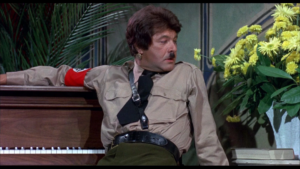
I think The Producers (Mel Brooks, US, 1967) might be an example of particularist camp– such as Brooks’ “Jewish camp”– which works for the in-group but lack consciousness for others, like Camp in the (canonical/popular/more-agreed) queer sense. The film centers on two Jewish producers attempting to make a Broadway flop by joining a Nazi playwright with queer Broadway creatives. However, their scheme unravels as their serious efforts to make the most exaggeratedly repugnant musical surpasses the audiences’ disgust and becomes enjoyable in spite of the Nazi content, mirroring Babuscio’s idea of camp shifting focus from “what a thing or a person is to what it looks like” (Babuscio 124).
I appreciate how Brooks’ camp portrayal of Nazism renders absurd all the artifice needed for an ideology of a ‘national rebirth’, ‘new man’, and ‘master race’; modernity claiming primordialism; fanatics deluded into “Being-as-Playing-a-Role” (Sontag 280).
Yet how Brooks’ characters achieve exaggeration is through effeminacy, hiring a gay director and a hippy-Hitler, whose reveal is what ultimately turns the audience to appreciate the play through mocking laughter. This is real crabs-in-a-bucket mentality, which Ross explores in his history: the effect of drag’s anti-passing camp was partly “ritual self-deprecation” by embodying the “social expression of the parent culture’s misogynistic forms”– possibly “survivalist” but “never an oppositional critique” (Ross 162-3). If camp is to embrace “life-as-theater” in order to be free, purposeful camp must challenge the roles that confine the producer themself: it’s okay to be a shanda fur die goyim, we’re always going to be otherwise.
[P.S. I am sparing you all the grotesqueness of the remake, which somehow managed to age worse since 2005 than the original 1967 version, though its Springtime for Hitler is much more overt in these regards]